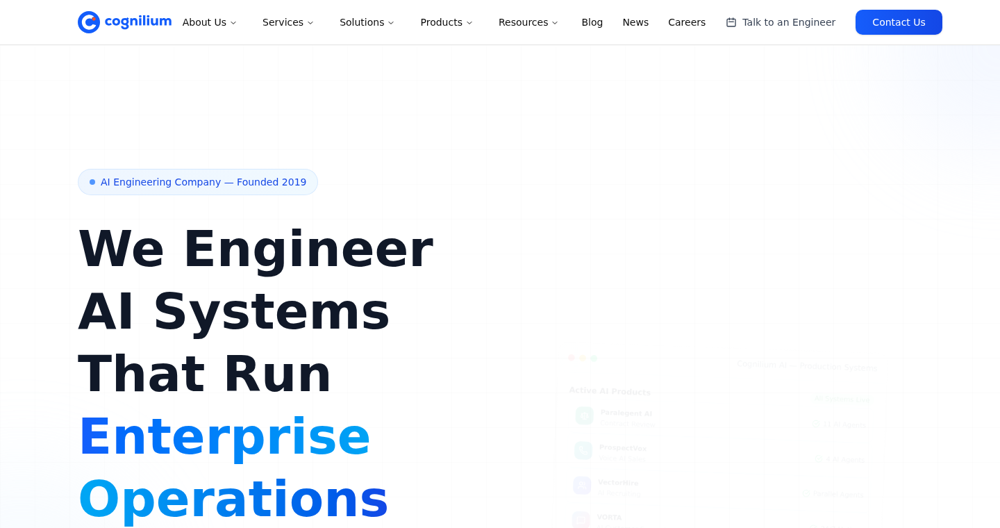
The same job, at company scale
Cognilium AI is the company (founder and CEO: Muhammad Mudassir). The products and the engineering behind them are not mine. What is: the content, the channels, the search and answer-engine layer, the distribution system and the growth motion.
The problem
What I did
- Built the site as a company surface rather than a brochure: product pages, service pages, industry pages and solution pages, each written to answer a buyer's question rather than to fill a template.
- Ran the search layer as automation on every deploy rather than as a periodic audit: metadata validation that fails the build when it is wrong, sitemap and content verification, machine-readable summaries generated from the site itself, then indexing pushed to every engine that accepts it. SEO for the ranked links, AEO and GEO for the answer engines that now sit in front of them, and the newsroom rules on top, which are a third rulebook again.
- Applied the published research on what answer engines actually reward, rather than guessing: inline statistics, cited authorities, expert quotes and comparison tables, used because they measurably move citation rate.
- Stood up a newsroom section built to the news carousel's structural rules, which are a different rulebook from ordinary search and invisible if you get the article type or the sitemap wrong.
- Built topical clusters rather than isolated posts, each pillar linked to its spokes and back, because authority accrues to a subject and not to a page.
- Moved the whole content operation onto a proper CMS and ripped the old one out rather than leaving both running, so every post gets its structure, its schema and its internal links from the template instead of from whoever wrote it.
- Wrote against experience, expertise, authoritativeness and trust (E-E-A-T) rather than against a keyword: named authors with a reason to be believed, checkable sources, and claims a reader can verify. It is the part of the work a competitor cannot copy quickly, which is exactly why most skip it.
- Built the publishing machine, which is the piece that makes the rest of it compound: one publish in the CMS fires everything else. The piece syndicates itself across the developer and social platforms, the feeds update, the search engines get pinged, the newsletter goes out. Nobody schedules any of it, so the tenth post costs the same effort as the first and no channel gets quietly dropped because a person was busy.
- Kept the platform inventory as a maintained document rather than tribal knowledge, so the accounts, the relationships and what each one is for survive a handover.
- Ran the same outbound motion on top, aimed at services rather than a single product: ICP research, then named prospect lists sourced and enriched in Clay down to a verified person, not a role inbox.
- Kept the cold email on its own infrastructure: separate sending domains and mailboxes, warmed, with deliverability held under SPF, DKIM and DMARC, and sequences written to earn a reply rather than an open.
- Worked the LinkedIn loop in order: target list, engagement on their posts, connection request, conversation, pitch. Done by hand, because that order is what makes the connection land and because automating it breaks the platform's terms.
- Ran it as one motion with stages that have exits: open cold, qualify, pitch the services, then close small or hand off warm.
The result
Doing this across a portfolio rather than one product changed what counts as done. On one site you can hold the whole thing in your head and fix what drifts. Across a company you cannot, so anything that depends on remembering will rot: a metadata rule nobody enforces, a syndication step someone has to trigger, a platform account one person knows the login for. The work stopped being about doing it well once and became about making the wrong version impossible to ship. That is why the checks live in the build and the distribution fires off a publish event, not off a person.