Everything between a product and its customers
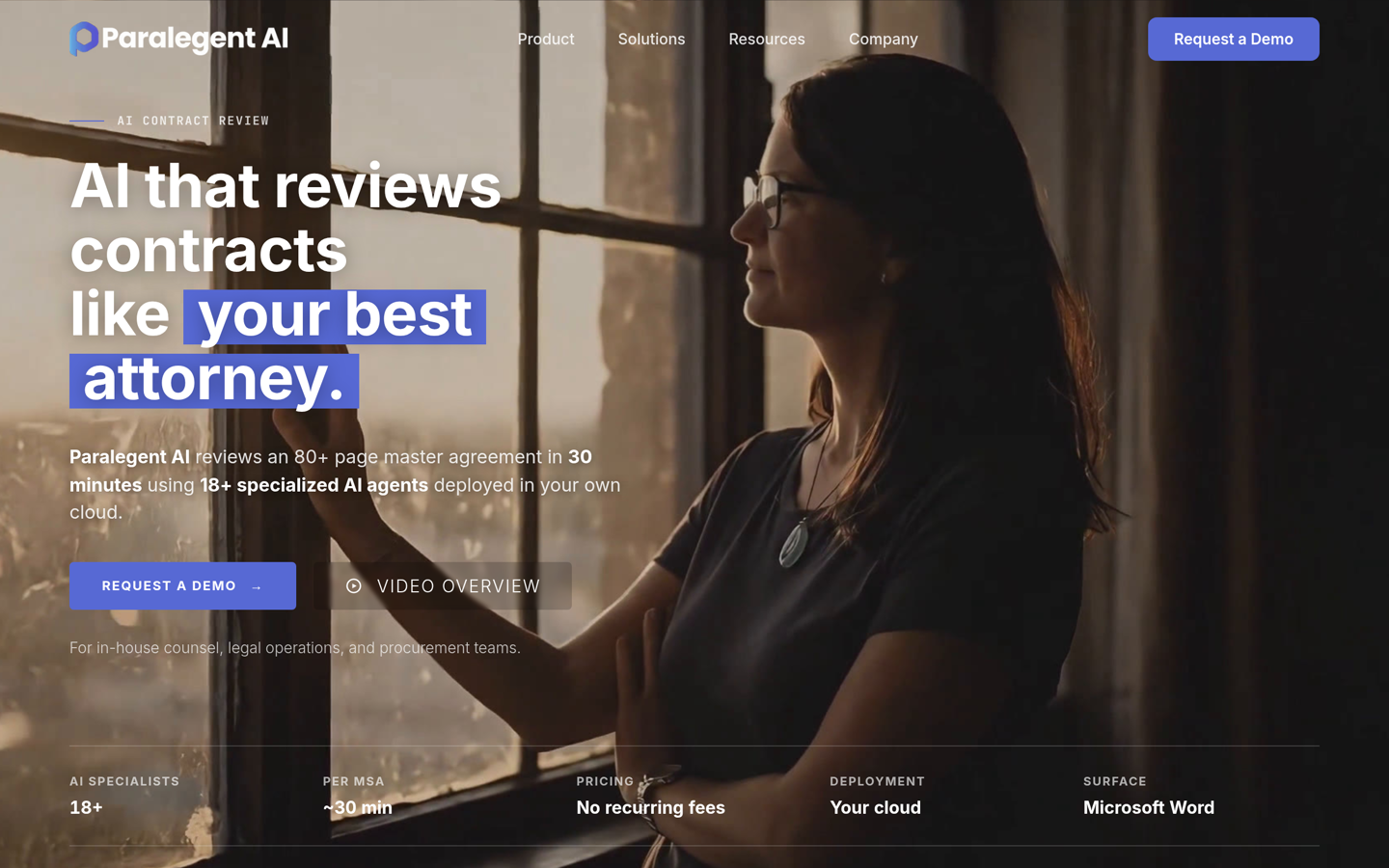
Paralegent AI is a Cognilium product (founder and CEO: Muhammad Mudassir). The product and the engineering behind it are not mine. The market-facing surface is: research, strategy, the pipeline, brand, site, search, content, social, authority and outbound.
The problem
What I did
- Started with the buyer, not the site: ICP research to decide which segments were worth building for, and which to leave alone. Everything downstream is cheaper once that is settled and ruinous when it is not.
- Designed the pipeline before filling it: the route from a stranger seeing the name to a booked conversation, written down as stages with an owner and an exit condition for each. Channels get built against that map, so a new one has to earn a place in it rather than being added because it exists.
- Rebuilt the brand on the live site rather than behind a holding page. A full palette migration token by token, a new wordmark, and a type system iterated in production instead of signed off in a deck.
- Wrote the design system as code, so the rules are enforced by the build rather than by a document nobody opens.
- Built the pages a buyer actually needs: industry pages for the tier-one segments, a glossary pillar carrying structured markup so each term can be quoted whole by an answer engine, and product pages rebuilt around what the thing does.
- Made every page carry evidence rather than adjectives: a floor for researched, cited data points per page, enforced by the same build gate as the rest of the design system. It is also what makes a page quotable, since an answer engine lifts a fact and skips a claim.
- Shipped the search layer as automation that runs on every push rather than a one-time audit: schema on every page type, sitemaps, feeds, and submission to the engines that accept it. SEO for the ten blue links, AEO and GEO for the answer engines that increasingly sit in front of them.
- Wrote to the framework the raters actually use, rather than to a keyword: experience, expertise, authoritativeness and trust (E-E-A-T), which in practice means a named author with a reason to be believed, sources that are checkable, and claims a stranger could verify without taking anyone's word for it. It is also the only part of search work that a competitor cannot copy in an afternoon.
- Ran the blog as a system rather than a stream: pieces written against clusters so the site accumulates authority on a subject instead of a scattering of posts, each one published through a CMS so the structure, the schema and the internal links come from the template and not from whoever is writing that day.
- Built the authority layer, which is the part most teams skip: consistent identity across the platforms that get read and cited, so a machine asked about the product finds the same answer everywhere.
- Ran the content and the films. Both were scripted, voiced and cut entirely with generative models, with no camera and no crew: one explaining what the product does, one arguing a point of view about the category it sits in. The second is the harder job, because a product film only has to be clear and a brand film has to be worth someone's attention without asking for anything.
- Ran the social channels as a channel: posting, engagement and community, building an audience the product owns rather than renting attention.
- Built the prospecting layer: the ICP turned into an actual named list, sourced and enriched in Clay down to a verified person with a verified address, because a sequence sent to a role inbox is a sequence sent nowhere.
- Stood up the cold email infrastructure rather than borrowing the company's: separate sending domains, mailboxes, warmup, and deliverability held under SPF, DKIM and DMARC. Most cold email fails in the spam filter, not in the copy, and that is decided before a single line is written.
- Wrote the sequences for replies rather than opens, with follow-ups that add a reason to answer instead of repeating the ask, and ran them from a dedicated sending tool kept apart from the company's real mail.
- Ran the LinkedIn loop in its real order: target list, then engagement on their posts, then the connection request, then conversation, then the pitch. Manually, in that sequence, because it is the sequence that works and because automating the connection step breaks the platform's terms.
- Held the whole motion to one shape: open cold, qualify, pitch, then either close something small or hand it over warm. Every stage has an exit, so nothing sits in a pipeline forever being counted as progress.
- Ran webinars as the format that does what a landing page cannot: a real person answering the objection in the room.
- Documented the lot as runbooks, so what is inherited is a system rather than a mystery.
The result
Running every layer for one product taught me they do not add up, they multiply or they cancel. A brand nobody can find is decoration. Traffic to a page that does not answer the question is a bounce. An outbound list pointed at a site with nothing to read on it burns the list, and the list is the expensive part. The temptation is to run them as separate projects, because that is how they are usually staffed, and separate is exactly what makes each one weak. The judgment was sequencing: deciding what had to be true before the next thing was worth starting, and saying no to the ones that were not ready yet.